Hex Match
- 4.6
- Rating
- 1.00M
- Installs
- Free
- Price
 Analysis by App-foxy
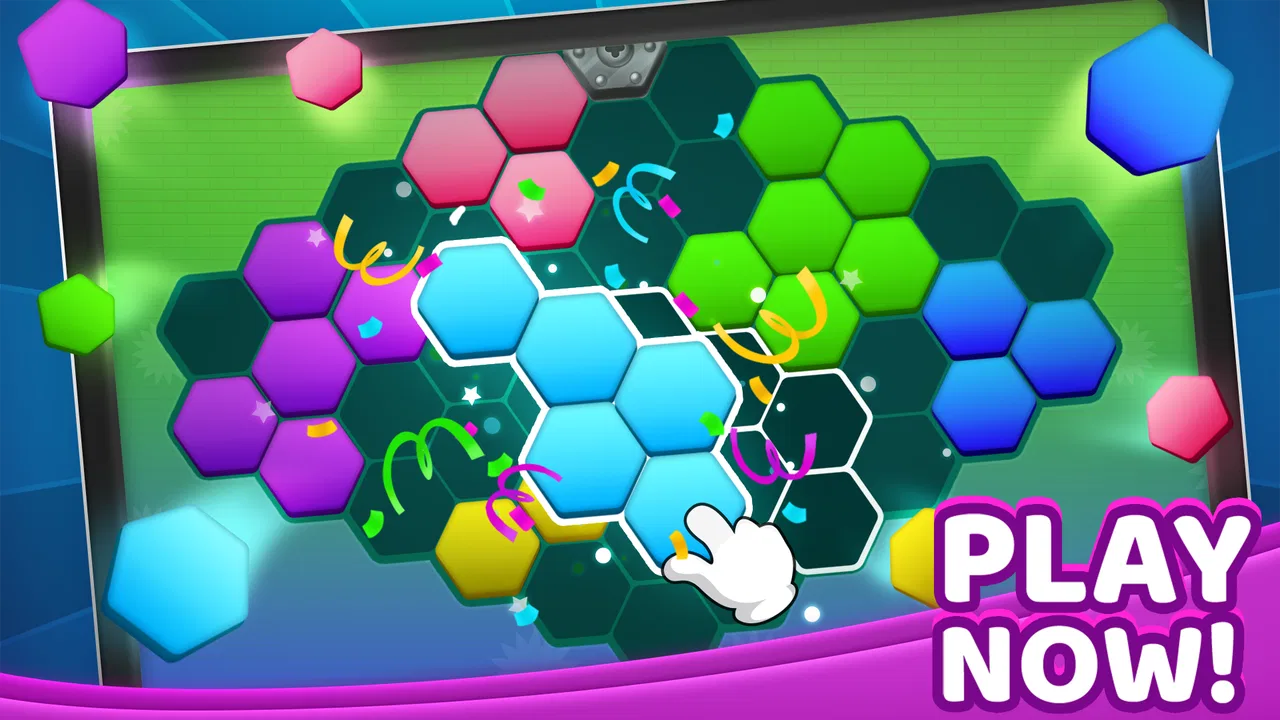
I approached Hex Match as the kind of puzzle I could open for a few spare minutes, not as a game that demands a long session. Developed by Gimica GmbH, it belongs to the casual puzzle side of mobile gaming and uses a simple idea: place hexagonal blocks on a board so that matching pieces disappear or combine according to the current challenge. That sounds familiar, but the hexagonal layout gives each decision a slightly different rhythm from the square grids used by many match and block puzzles.
My first impression was that the game is easy to understand almost immediately. You do not need a long tutorial or a complicated set of rules before making a useful move. The real work begins after that first comfortable stage, when the board becomes crowded and a placement that looks good now may leave an awkward gap for the next piece. The important skill is not placing blocks quickly; it is preserving useful space for the move after the move.
It is free to download and suitable for Everyone, which makes it an approachable choice for family devices or for someone who wants a low-pressure puzzle. The current version is 1.4.1, and it runs on Android 7.0 or later. On the store, it has an average rating of 4.6 from around 78 thousand ratings, with more than 1 million installs. Those figures fit my experience: this is a broadly accessible game rather than a niche puzzle designed only for dedicated strategy players.
You May Also Like

 Blood Strike: 2.5 Anniversary
Blood Strike’s Loadouts Turn Every Drop Into a Tactical Gamble
A close look at Blood Strike’s custom loadouts: how fast access to signature weapons reshapes its battle royale rhythm, rewards preparation, and narrows the gap between fights.

 Pandora - Music & Podcasts
Pandora’s Music Is Easy to Start, but Harder to Recover
Pandora’s strength is its low-effort path from a seed to a station. Its weak spot is how much confidence it asks you to place in connection, setup, and quiet recovery.

 8 Ball Pool
 Is Built on Rivalries, Rematches, and Routine
A close look at the rivalries, rematches, shared routines, and unanswered safety questions that turn a quick pool match into a persistent mobile community.

 Samsung Music
’s Quiet Strength Is Playing What You Already Own
Its reach comes less from spectacle than from dependable access to a personal library. That simplicity is both the app’s strongest retention engine and its ceiling.

 AccuWeather: Weather Radar
AccuWeather Review: A Quick, Clear Forecast for Everyday Decisions
For everyday plans, the best forecast is the one you can understand quickly. AccuWeather makes rain timing, radar, and local conditions easy to act on, with a few trade-offs.

 Hill Climb Racing
Why Hill Climb Racing Still Turns Crashes Into One More Run
A tiny car, a bumpy hill and one more upgrade: Hill Climb Racing keeps resurfacing because its simple chaos makes every near-miss feel personal.
More From Our News Desk



How I play a normal session
My baseline workflow is deliberately simple. I begin by looking at the entire board instead of dragging the first piece toward the most obvious empty area. With hexagonal spaces, it is easy to focus on one attractive opening and miss how the surrounding cells connect. I check the available shapes, identify which one is hardest to place, and try to solve that constraint before using the flexible pieces.
That habit matters because a piece with a narrow fit can become impossible after one careless placement. A broad piece may look more important because it occupies more space, but it often has several possible destinations. I treat the awkward piece as the immediate problem and the versatile piece as a tool I can save. This makes the game feel less like random tapping and more like a small planning exercise.
When a placement creates a match, I do not automatically assume it is the best move. Clearing space is helpful, but removing a group can also change the shape of the remaining board. Sometimes I prefer a move that leaves a clean pocket for a future block over a move that produces a quick visual reward. That is one of the first differences between casually filling the board and playing with a repeatable method.
A realistic use case is a short break between tasks. I can play one or two rounds while waiting for a train, sitting in a reception area, or taking a pause from work without needing to remember a large story or a complex control scheme. The game’s central action is easy to resume after an interruption. I would not choose it for a long evening of narrative entertainment, but it works well when I want my attention occupied without being overwhelmed.
The game is also a good fit for people who enjoy visual organization. If you like sorting objects into patterns, filling spaces neatly, or solving a board by reducing clutter, its appeal is clear. On the other hand, anyone looking for word clues, a story campaign, character progression, or deep tactical combat will find the experience too narrow. Its pleasure comes from arranging shapes, not from building a larger world around the puzzle.
What I check before committing to a move
I use three quick questions. First, which current piece has the fewest realistic homes? Second, will this placement leave a one-cell or narrow pocket that future pieces cannot use? Third, am I clearing space because it improves the board, or simply because the match is available? These questions take only a moment once they become habitual, but they reduce the number of moves made on impulse.
I also rotate my attention around the board rather than reading it from left to right. A promising opening on one side can hide a better arrangement elsewhere, especially when several pieces can connect through the same cluster. Looking at the board as a set of linked spaces helps me notice that the best move is often the one that keeps two regions open at once.
One useful rule is to avoid filling the center too early when the outer spaces are still flexible. The center often acts as a bridge between possible arrangements. If I block it with a piece that could have gone elsewhere, I may split the board into separate pockets. This is not a formal instruction presented as a special feature; it is simply a practical way to make the geometry work in my favor.
Settings and habits worth checking
Hex Match is not a game where I expect settings to transform the strategy. I still check the available audio, notification, and general gameplay options before settling into regular use, because a puzzle played in short bursts should fit the situation. If I am using it during a quiet break, I prefer not to have sound become the focus. If I am playing at home, I may leave feedback enabled because it makes successful placements easier to follow.
My advice is to treat settings as part of the playing environment rather than as a source of hidden advantages. There is no reason to search for a secret option that will solve difficult boards. The useful adjustment is practical: make the game comfortable to read, easy to pause mentally, and unobtrusive when you are multitasking. That is especially relevant for a puzzle intended for quick sessions.
I also avoid beginning a round while doing something that requires constant attention. The controls may be simple, but the board still rewards concentration. A distracted placement can create a bad pocket that takes several moves to repair. The game is forgiving in its basic presentation, yet the consequences of a careless decision become more noticeable as the available space decreases.
Because the game is free, I would also look at the purchase prompts with a clear idea of what I actually want from it. Optional in-app purchases range from $1.99 to $7.99 per item. I do not consider spending necessary to understand the core puzzle, but players who dislike interruptions should decide early whether they are comfortable with the free version’s presentation. The right approach is to enjoy the basic loop first rather than buying anything before knowing whether the board style suits you.
For parents, the Everyone rating makes the game easier to consider for a shared device, but I would still explain that free games can present optional purchases. The rating describes the content, not a promise that every player will enjoy the same pace or presentation. A child who likes arranging colorful shapes may enjoy it, while another may become frustrated when a board fills and a preferred move is no longer available.
My repeatable short-session routine
When I have only a few minutes, I use a small routine. I scan the pieces, reserve the least flexible one mentally, place the piece that opens the most future space, and then reassess rather than continuing automatically. After each clearing move, I pause for a complete board check. This prevents the common mistake of treating a successful match as permission to rush through the next placement.
That routine is more useful than trying to memorize a fixed opening. The pieces and board situations can require different responses, so a rigid sequence is less reliable than a simple decision process. The main benefit is consistency: I make fewer moves based only on the most visible gap, and I notice earlier when a board is becoming difficult to recover.
Faster patterns without careless play
Experienced play in this kind of puzzle is not really about speed. It is about reducing unnecessary thought. Once I recognize a familiar shape, I can compare its possible positions quickly instead of testing every empty space. I look for placements that do two jobs at once: completing a match while also opening a useful lane, or filling a troublesome pocket while keeping a larger region available.
One pattern I watch for is the “false fit.” A piece may technically fit in a space but leave a jagged edge that accepts very little afterward. I call it false because the immediate placement is legal and tidy, yet the resulting board is worse. When I see that shape, I compare it with a less attractive location that preserves a smoother boundary. The smoother boundary usually gives me more options on the next turn.
Another pattern is the delayed clear. If a group can be completed now, I consider whether waiting one move could create a larger or more useful opening. I do not delay every match; that would be just as rigid as clearing everything immediately. I delay only when the current arrangement is stable and the next piece appears likely to benefit from the extra space. This is a trade-off between immediate relief and future flexibility.
I also try to keep at least two active areas rather than building one dense cluster. A single central pile can look efficient, but it makes the next piece dependent on one small region. Two open areas give me a fallback when a shape does not fit the first plan. This is particularly useful during a short session when I may be interrupted and need to understand the board again quickly.
For people coming from standard block puzzles, the biggest adjustment is the hexagonal geometry. Familiar habits from square grids do not always transfer cleanly because neighboring spaces are arranged differently. I recommend slowing down during the first few rounds and learning to see connected edges rather than imagining rows and columns. Once that visual shift happens, the board feels less unusual and decisions become more intuitive.
When the usual alternatives are better
Compared with a traditional match-three game, this offers less emphasis on chain reactions and more emphasis on spatial management. If you enjoy planning a board and protecting open areas, that difference is a strength. If your favorite part of a match-three game is triggering dramatic cascades with a single swipe, you may find this experience quieter and more deliberate.
Compared with a classic falling-block game, it gives me more control over where pieces go, so the pressure comes from planning rather than reacting to a continuously descending board. That makes it more comfortable for relaxed play, but perhaps less exciting for someone who wants a timer, constant motion, or a strong arcade feel. A word puzzle would be a better choice when I want language practice, and a logic-grid game would suit me better when I want deduction from explicit clues.
The trade-off is clear: Hex Match is easy to enter because the rules are visual, but its depth is limited to the placement system. I would recommend it to a friend who wants a compact spatial puzzle. I would steer a friend elsewhere if they need a long-term progression system, competitive multiplayer, or a story to provide motivation between puzzles.
Where the challenge starts to show its limits
The same simplicity that makes the game approachable can make it feel repetitive. After I understand the basic placement habits, the experience depends heavily on whether the current boards continue to present interesting spatial decisions. Players who need frequent new mechanics may eventually feel that they are solving variations of one central problem rather than discovering a larger system.
There is also a psychological limit to the clean-board strategy. Trying to keep every area perfect can make me hesitate too much. A puzzle board is not always recoverable through ideal play, and sometimes I must accept an imperfect edge to gain immediate room. If I become obsessed with preserving a flawless arrangement, I spend more time searching for a theoretical move than making a practical one.
Another limitation is that the game’s relaxed accessibility may not satisfy people who want a clearly escalating challenge. The store description presents it as fun and challenging, but the appeal is not the same as a demanding competitive puzzle. I judge a round by the quality of my decisions, not by expecting a dramatic difficulty curve. That distinction matters before downloading: the game is best viewed as a calm spatial exercise with moments of pressure.
Optional purchases are another consideration. The game is free, but the listed in-app purchase range means the experience may include reasons to spend money. I would keep the free version installed first and observe how naturally it fits my routine. If the interruptions or purchase prompts become more noticeable than the puzzle itself, that is a sign that the game is not the right match for my preferences, regardless of its strong average rating.
Device compatibility is straightforward for many Android users because the minimum requirement is Android 7.0. Still, an older device may offer a less comfortable experience than a newer one, particularly if the screen is small or touch input is inconsistent. The pieces need to be placed accurately, so I would test the controls before judging the strategy. A puzzle that feels precise on one phone can feel cramped on another.
Who should skip it
I would skip this game if I want a campaign with characters, a strong narrative, or a sense of unlocking a world. I would also skip it if I become frustrated by boards where the best outcome depends on accepting a less-than-perfect arrangement. The game asks for patience and spatial compromise; it does not always reward the move that looks neatest.
It is less suitable for someone who wants a social game with direct competition. The experience I get is personal and board-focused, so its motivation comes from improving my own choices rather than reacting to another player. Likewise, if I need a puzzle that teaches a specific skill, such as vocabulary or formal logic, this is entertainment rather than structured practice.
For everyone else, the low entry barrier is a genuine advantage. I can hand it to someone who has not played mobile puzzles before and explain the basic idea quickly. The more advanced habits then emerge naturally: protect flexible space, solve awkward pieces early, and do not confuse an immediate match with a good long-term move.
My mastery verdict
After spending time with it, I see Hex Match as a focused, approachable puzzle that earns its place through the feel of its board rather than through a large collection of systems. Gimica GmbH keeps the central interaction understandable, and the hexagonal layout gives familiar block placement a distinct visual problem. I enjoy it most when I treat each round as a small planning exercise instead of trying to rush toward the next clear.
My strongest recommendation is to build a habit around board preservation. Check the least flexible piece first, avoid false fits, keep more than one region open, and reassess after every successful clear. These methods do not turn the game into something it is not, but they make the existing puzzle more satisfying and help prevent avoidable dead ends.
The free entry and Everyone rating make it easy to try, while the Android 7.0 minimum keeps it accessible on a broad range of devices. The rating of 4.6 and install base of over 1 million suggest that many players find the format appealing, but I would not use popularity as a substitute for matching the game to my taste. Its calm, repetitive structure is either a strength or a weakness depending on what I want from a mobile game.
I recommend it for short, thoughtful sessions when you want a clean spatial puzzle without a story or complicated controls. I would choose another game for competitive energy, narrative progression, or constantly changing mechanics. For me, the best time to play is during a brief pause when I can focus on one board, make a few careful placements, and stop feeling that I have used my break on something noisy or demanding.
In the end, this is not a game I would install for spectacle. I would install it because the hexagonal board gives me a compact problem to solve, and because its simple rules leave room for better habits. If that kind of quiet challenge sounds appealing, the free version is a sensible place to begin.
FAQs for Hex Match
01What is Hex Match and how does it work?
Hex Match is a strategic puzzle game available on Android and iOS where players match hexagonal tiles of the same color to score points. The objective is to connect as many tiles as possible in one move, creating chain reactions for higher scores. The game challenges your planning skills and offers various levels of difficulty to keep you entertained.
02Are there in-app purchases in Hex Match?
Yes, Hex Match offers in-app purchases. Players can buy additional hints, lives, or power-ups to enhance their gameplay experience. While the game is free to download and play, these purchases can help players progress through challenging levels or achieve higher scores more quickly.
03Does Hex Match require an internet connection to play?
Hex Match can be played offline, which is great for users who want to enjoy the game without a constant internet connection. However, certain features like leaderboards or daily rewards may require an internet connection to access fully. This makes it versatile for both on-the-go play and at-home sessions.
04Is Hex Match suitable for all ages?
Hex Match is designed to be family-friendly and suitable for all ages. Its simple yet challenging gameplay appeals to both kids and adults. The intuitive controls and colorful graphics make it accessible for younger players, while the strategic elements provide depth that older players will appreciate.
05How can I track my progress in Hex Match?
Hex Match includes a progress tracking feature where players can view their achievements, high scores, and level completions. Additionally, if connected to the internet, players can compete with friends or other players globally through the leaderboard, adding a competitive edge to their gameplay experience.
Pros
- Engaging puzzle mechanics.
- Visually appealing design.
- Smooth and intuitive controls.
- Regular updates with new levels.
- Offline play available.
Cons
- Ads can be intrusive.
- No multiplayer mode.
- Limited free hints.
- In-app purchases can be pricey.
- Sound options are limited.

Hex Match
Gallery